Methylene Blue: What It Is Approved For, and What It Is Sold For
A plain guide to the one condition it is approved to treat, what the human evidence actually shows, the drug interaction that matters most, and who should not have it at all.
Methylene blue is having a moment. It turns up in wellness clinics, in supplement droppers, and in a great deal of confident advice about mitochondria. It is also a genuine medicine with a genuine, narrow approved use, and a drug interaction serious enough to carry a boxed warning.
We offer it as an infusion at EverVive, so weigh what we say with that in mind. We have tried to write the page we would want a family member to read before saying yes.
What methylene blue actually is
It is a dye, first made in 1876, and one of the oldest synthetic drugs still in clinical use. Chemically it is an oxidation-reduction agent: it accepts and donates electrons. That property is why it stains tissue, why it turns urine blue, and why it works for the one condition it is approved to treat.
The one thing it is approved for
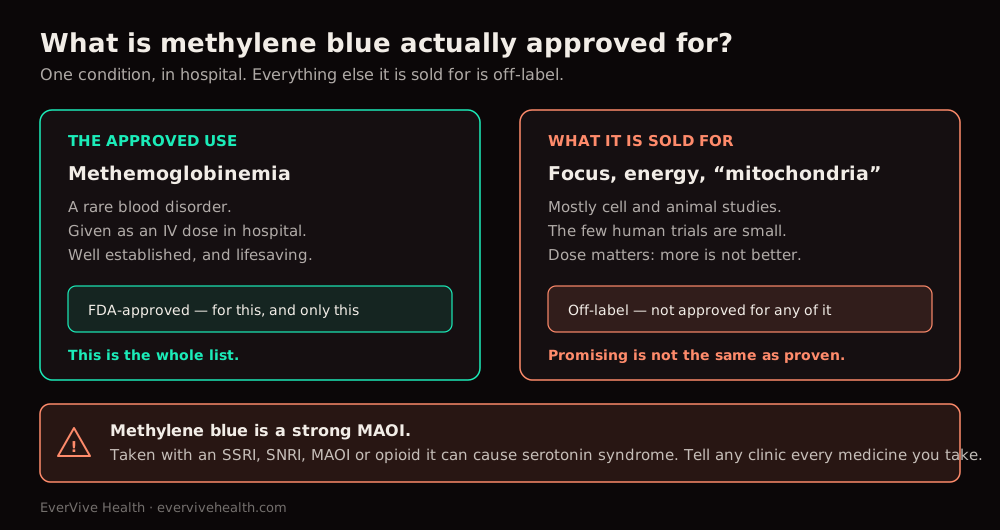
The injectable form is approved for acquired methemoglobinemia — a disorder in which haemoglobin is chemically altered so that it cannot release oxygen to tissue. Methylene blue converts it back. Given intravenously in hospital, this use is well established and can be lifesaving.
That is the entire approved list. Not focus. Not energy. Not mitochondrial health, long COVID, mood or ageing. When a clinic says “FDA approved” without naming the condition, that word is doing work it has not earned.
What it is sold for, and what the evidence shows
The interesting idea behind the wellness use is real: because methylene blue can shuttle electrons, it may be able to support mitochondrial respiration when the normal chain is impaired. Most of the supporting work is in cells and in animals.
The human evidence is thin. The trials that exist are small, short, and few, and they do not establish that methylene blue improves cognition, energy or longevity in healthy people. A derivative was taken into large trials in Alzheimer’s disease and did not meet its primary endpoints, which is worth knowing before treating the mitochondrial story as settled.
Promising is not the same as proven. We think it is reasonable to find this interesting. We do not think it is reasonable to sell it as established.
The interaction that matters most
If you read only one section, read this one. Methylene blue inhibits monoamine oxidase A, the enzyme that breaks serotonin down. Combined with medication that raises serotonin, it can cause serotonin syndrome: agitation or confusion, muscle twitching, sweating, tremor, diarrhoea, poor coordination and fever. Severe cases have involved seizures and coma, and deaths have been reported.
The prescribing information carries a boxed warning — the strongest warning a label can carry — describing the combination as potentially fatal, and directs prescribers to avoid giving it alongside SSRIs, SNRIs, MAOIs and opioids. Most reported cases involved intravenous dosing in people taking an antidepressant.
Two practical consequences. First, tell any clinic every medicine and supplement you take, including ones you stopped recently — some antidepressants clear slowly, so the risk outlasts the last tablet. Second, a clinic that does not ask you this before offering an infusion has told you something important about how it operates.
Dose is not a detail
Methylene blue does not behave in a straight line. At low concentrations it acts as an electron carrier; at higher concentrations it flips and becomes pro-oxidant — the opposite of what most people are taking it for. There is no sense in which more is better.
This is also why the source matters. Laboratory-grade and aquarium-grade methylene blue are not pharmaceutical products, are not made to the same purity standards, and have no place in anything you put into a vein.
Who should not have it
- Anyone with G6PD deficiency. This is a contraindication on the label: methylene blue can trigger the destruction of red blood cells. It should be tested for rather than assumed.
- Anyone taking serotonergic medication — SSRIs, SNRIs, MAOIs, certain other antidepressants, and opioids — unless a physician has judged the benefit to outweigh a boxed-warning risk.
- Anyone pregnant or breastfeeding.
- Anyone with significant kidney impairment, where dosing has to be reduced and reconsidered.
- Anyone with a known hypersensitivity to methylene blue or to thiazine dyes.
What to expect if you do have it
Expect blue. Blue or green urine for a day or two is normal and harmless. The skin and the whites of the eyes can take on a tint. Methylene blue also interferes with pulse oximetry and can make an oxygen reading look falsely low, which is worth knowing if you are wearing a monitor.
At our clinic in Jacksonville Beach, methylene blue is given as part of our IV therapy service, after a medication review and the screening described above — and not at all if that screening says no.
Questions people ask
What is methylene blue used for medically?
It has one approved use: acquired methemoglobinemia, a blood disorder in which haemoglobin cannot release oxygen properly. Given as an intravenous dose in hospital, it is well established and can be lifesaving. Every other use you see advertised is off-label.
Is methylene blue FDA approved?
The injectable form is approved, but only for acquired methemoglobinemia. It is not approved for focus, energy, mood, mitochondrial health, long COVID or ageing. A clinic saying “FDA approved” without naming the condition is leaning on a word that does not cover what they are selling.
Does methylene blue improve focus or energy?
Most of what is claimed comes from cell and animal work. The human trials are few and small. That makes it an interesting question, not a settled answer, and we will not tell you otherwise.
Can you take methylene blue with an antidepressant?
This is the most important question on the page. Methylene blue inhibits monoamine oxidase A, so combining it with serotonergic medication can cause serotonin syndrome. The label carries a boxed warning describing this as potentially fatal and says to avoid SSRIs, SNRIs, MAOIs and opioids. Tell any clinic every medicine you take, including ones you have recently stopped.
Is methylene blue safe if you have G6PD deficiency?
No. G6PD deficiency is a contraindication on the label, because methylene blue can trigger the destruction of red blood cells. It should be tested for, not assumed.
Why does methylene blue turn your urine blue or green?
Because it is a dye. Blue or green urine is expected and harmless. It can also tint the skin and the whites of the eyes, and it can make a pulse oximeter read falsely low, which matters if you are being monitored.
Is a higher dose better?
No. The dose-response is not a straight line: at low concentrations methylene blue behaves one way and at higher concentrations it turns pro-oxidant, which is the opposite of the effect people are usually after. More is not better, and dosing it casually is the main way people get hurt.
Is IV methylene blue better than taking it by mouth?
Intravenous dosing bypasses the gut and gives a predictable blood level, which is why the hospital use is intravenous. It does not make the off-label claims any better evidenced, and it raises the stakes if a drug interaction has been missed.
Where these facts come from
The regulatory statements on this page come from the approved prescribing information for the intravenous product: the ProvayBlue label on DailyMed and the FDA-hosted label PDF. The boxed warning, the approved indication and the G6PD contraindication are all stated there.
About this article. This is educational information, not medical advice, and it is not a substitute for assessment by a qualified clinician. Nothing here describes a guaranteed outcome. Methylene blue carries a boxed warning for a serious drug interaction; if you are considering it, the useful next step is a consultation where your history and your full medication list can be reviewed properly.