PRP or Stem Cells for Hair Loss? What the Evidence Shows
Three very different treatments get sold for thinning hair in Jacksonville. One group is FDA-approved, one has reasonable evidence, and one is being enforced against. Here is which is which.
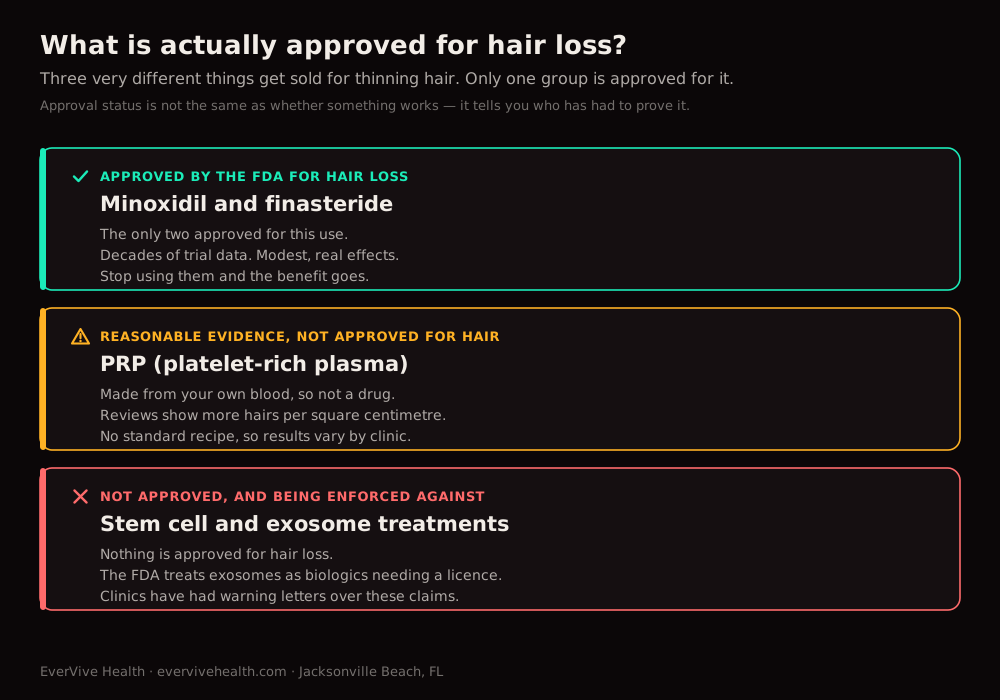
Look into hair loss treatment around Jacksonville and you will meet three things. PRP. Stem cell or exosome treatments. And the two approved drugs. They sound similar. They are not.
This page sorts them out. We offer PRP, so weigh what we say with that in mind. We will also tell you plainly which of these we will not sell you.
What PRP is, in plain terms
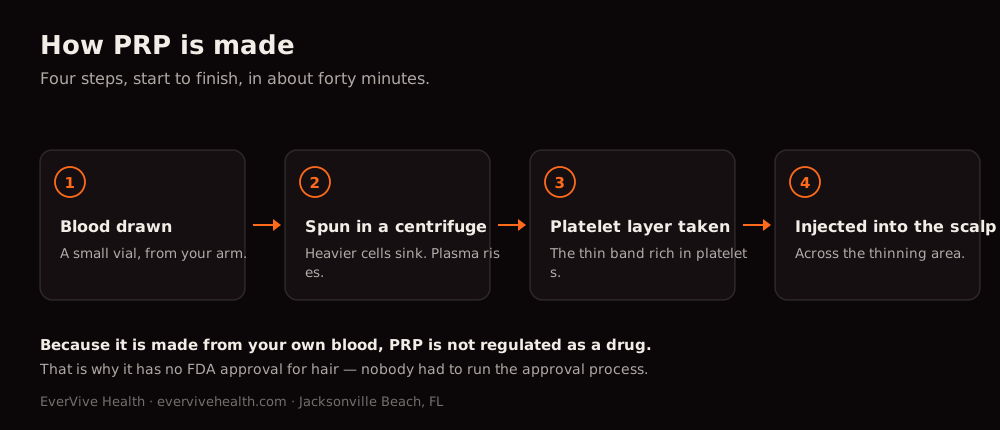
PRP stands for platelet-rich plasma. A small amount of your blood is drawn and spun in a centrifuge. That separates out the layer thick with platelets. The platelets are then injected into your scalp.
Platelets are known for clotting, but they also carry growth factors. The idea is that putting those growth factors next to shrinking hair follicles helps them behave more like healthy ones. Because it is made from your own blood, PRP is not regulated as a drug. We wrote a fuller explainer on what platelets actually do.
What the research shows for hair
This is the part most pages skip or exaggerate. The honest summary is that PRP probably helps, by a modest amount, for the right kind of hair loss.
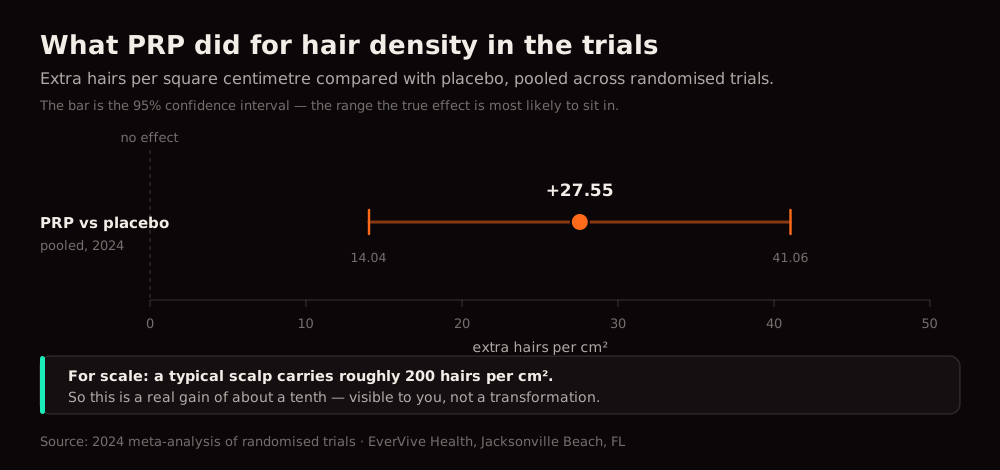
A 2024 meta-analysis of randomised trials found PRP produced about 27 more hairs per square centimetre than placebo. A separate systematic review of nine studies covering 291 people found six of them reported a real increase in density. Added on top of minoxidil, PRP did better than minoxidil alone at one, three and six months.
Now the caveats, because they matter. The reviewers rated much of this evidence as low quality. The trials disagree with each other. And there is no standard recipe for PRP — how fast it is spun, how many times, what is added, how often it is injected. Two clinics can both say “PRP” and give you different treatments.
So: reasonable evidence that it helps hair density. Not strong evidence. And the quality of your result depends partly on who prepares it.
Where stem cell and exosome treatments stand
This is where the gap between the marketing and the rules is widest.
No stem cell or exosome product is approved for hair loss in the United States. The FDA treats exosomes as biological products. That means they need a licence before they can be sold. None holds one for skin or hair use.
This is not a technicality that nobody enforces. In February 2026 the FDA sent a warning letter to a clinic over umbilical cord and exosome products. Part of the case rested on what the clinic said on its own website. In March 2026 the agency repeated a public alert that firms breaking these rules may face seizure or injunction without further notice.
The American Hair Loss Association takes the same line: these treatments belong in a regulated trial, not on a price list.
None of that proves they do not work. Some of the early safety data looks fine. It means nobody has yet shown they work well enough to be approved.
We offer donor-derived stem cell therapy, so we will say where that leaves us. It is not approved, the evidence is thin, and anyone who tells you otherwise is overstating it. What we will do is tell you that before you decide, give you the regulatory status in writing, and say plainly when we think PRP or an approved drug is the better place to start.
The two treatments that are approved
Worth saying out loud, because clinics selling the expensive options rarely do.
Minoxidil and finasteride are the only two treatments with FDA approval for hair loss. They have decades of trial data behind them. The effects are modest but real, and both have to be kept up — stop, and the benefit goes.
If you have not tried either, that is usually the first conversation to have, not the last. Any clinic that goes straight past them to a four-figure package is selling, not advising.
Who PRP helps, and who it does not
PRP works on follicles that are shrinking. It cannot bring back follicles that are gone.
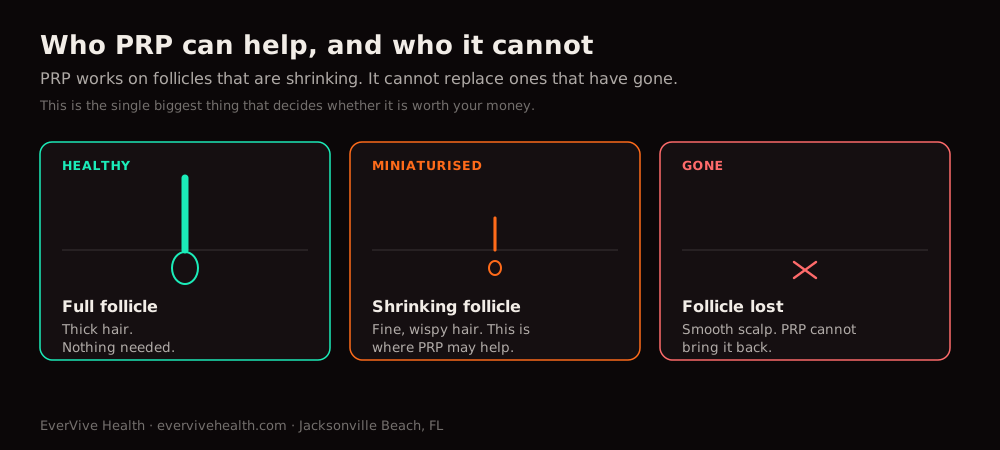
- Reasonable candidates: early to moderate pattern thinning, where you can still see fine hair in the thinning area.
- Poor candidates: long-standing bald areas with smooth scalp.
- Treat the cause first: thyroid disease, iron deficiency, a new medication and alopecia areata all cause shedding. PRP on top of an untreated cause is money spent on the wrong problem, so we run labs before we start.
Hair restoration in Jacksonville Beach
Our clinic is in Jacksonville Beach. We also see patients from Atlantic Beach, Neptune Beach, Ponte Vedra Beach, Ortega and Fernandina Beach.
We offer both PRP and donor-derived stem cell therapy, as part of our regenerative treatments. We have set out above where each one stands, and we would rather you read that before you book than after.
If you come to us about hair, PRP is where we will usually start, because it has the better evidence behind it. Where stem cell therapy is discussed, we will tell you its regulatory status and the limits of the evidence first. That conversation is part of the appointment, not an afterthought.
A first appointment is an hour. We look at your scalp, take a history, and run labs where something else might be driving the loss. Sometimes an approved drug is the better place to start. Sometimes the answer is that nothing will help much. We would rather tell you that than take the booking.
Questions people ask
Does PRP work for hair loss?
The reviews point the same way: PRP increases hair density compared with a control. One 2024 meta-analysis of randomised trials found about 27 more hairs per square centimetre. But the studies vary a lot in how the PRP was made, and the reviewers flagged publication bias. It is reasonable evidence, not settled evidence.
Is PRP for hair FDA-approved?
No, and that surprises people. PRP is made from your own blood, so it is not regulated as a drug. Only minoxidil and finasteride are FDA-approved to treat hair loss. PRP being unapproved is not the same as PRP being unproven — it means nobody had to run the approval process.
Is stem cell hair restoration FDA-approved?
No. No stem cell or exosome product is approved for hair loss in the United States. The FDA treats exosomes as biological products, so they need a licence before sale. None has one for skin or hair use.
Has the FDA taken action against these clinics?
Yes. Yes. In February 2026 the FDA sent a warning letter to a clinic over umbilical cord and exosome products. Part of the case rested on what the clinic claimed on its own website.
How many PRP sessions will I need for hair?
Most courses start with three to four sessions about a month apart, then maintenance. Be wary of anyone who quotes a number before looking at your scalp.
Does PRP for hair hurt?
The injections sting. The scalp is sensitive and the area treated is wide. Most clinics use ice or a numbing cream. It is uncomfortable rather than painful, and it is over in about twenty minutes.
Who is not a good candidate for PRP hair treatment?
People with very advanced loss, where the follicles are gone rather than shrunken, will not get much from it. Nor will people whose hair loss has another cause — thyroid disease, iron deficiency, a medication, or alopecia areata. Those need treating first, which is why we test.
How much does PRP hair restoration cost in Jacksonville?
It depends on how many sessions you need, so we quote at consultation rather than advertise a figure. Ask any clinic for the price of a full course, not one session.
Do you offer stem cell or exosome hair treatment?
We offer both. PRP is the better-evidenced of the two for hair. We also offer donor-derived stem cell therapy, and we will tell you plainly at consultation that it is not FDA-approved for hair loss and that the published evidence is limited.
Where are you based?
Jacksonville Beach. We also see patients from across Duval County and the beaches, including Atlantic Beach, Neptune Beach, Ponte Vedra Beach and Fernandina Beach.
About this article. This is educational information, not medical advice, and it is not a substitute for assessment by a qualified clinician. PRP is not FDA-approved for hair loss, and no stem cell or exosome product is approved for it either. Nothing here describes a guaranteed outcome. Last reviewed 16 October 2026.